
Scrolling on social media, it’s not long before I find myself faced with posts and arguments about the role of bisexual+ people within the LGBTQ+ community. Although I’m trying to keep my screen time at a minimum, I still feel that lately, I’ve seen more examples of posts criticising bisexual+ women for having relationships with men.
The concept of ‘decentering men’, and wanting to avoid women who do not also ‘decentre’ men keeps popping up on my feed. This ties closely with the idea that bisexual+ women are contributing to their own subjugation (and that of others) by ‘choosing’ to have intimate relationships with men, and it is not a new idea. It’s an example of biphobia that I have experienced myself, and I think it has a deep impact. It’s also a criticism almost always aimed specifically at bisexual+ women.

Often when I see these conversations happening on social media, I am aware that I may be looking at the voices of young LGBTQ+ people who are going through a learning process. They’re doing that in an incredibly public forum, as loudly as possible, because that’s normal for them – but it’s not always the case that this is just ‘baby gays’ on a learning journey. I think that as the specific risks that bi+ women face become more embedded in the consciousness of the online queer community, these attitudes can be seen as a backlash against it – a form of victim blaming.
For context, bisexual+ women are five times more likely to have experienced sexual violence by a current or former intimate partner compared to heterosexual women1 . Framing these experiences from the perspective that bisexual+ women are complicit in patriarchy and gendered violence, or even just accepting poor behaviour from men, contributes to the false idea that experiencing sexual violence at the hands of your partner could be your fault.
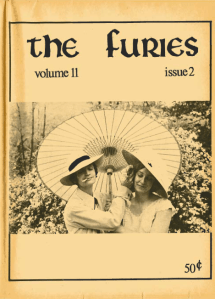
There is an article titled simply ‘BISEXUALITY’ from 1973 which tackles this topic. It was published by a feminist separatist collective from Washington D.C, founded in 1971, called The Furies2. In this 1973 issue of their publication, Loretta Ulmschneider wrote about the lesbian separatist perspective on bisexuality:
“Just as the existence of lesbians is not a new phenomenon, so the existence of bisexuals (women who relate sexually to both women and men) is not new”3.
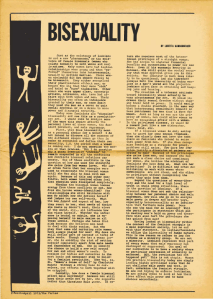
Not a bad start! Although the definition she uses of bisexuality is definitely simplistic. However, Ulmschneider goes on to present the biphobic, separatist perspective that bisexuality is an “indulgence” or choice that women make and that making this decision supports the patriarchy and is the responsibility of bisexual women to avoid. She proposes, that “the creation of a tolerant attitude toward bisexuality would actually be very advantageous for men,”4 because it gives them power.
There are several definitions of what it means exactly to be a feminist separatist, and what level that was taken to. The movement spanned lesbian women who would not associate with straight women, to those aiming for total autonomy, running communes, publishing houses, and even credit unions5. In the first issue of The Furies, the role of lesbian identity within this movement is described as “not a matter of sexual preference, but rather one of political choice which every woman must make if she is to become woman-identified and thereby end male supremacy”6.
The Leeds Revolutionary Feminist Group wrote in 1981 that a political lesbian is “a woman-identified woman who does not fuck men. It does not mean compulsory sexual activity with women”7. Those involved in what is known as the lesbian separatists movement were not necessarily lesbians in the sense that many would use the term today.
In the 1973 article about bisexuality published in The Furies, Ulmschneider proposes that bisexuality itself is inherently unfeminist, “how does her [the bisexual woman’s] feminism justify a diversion of primary energies to men?”8.
She also touches on what seems to be a personal vendetta about organising with bisexual women; “it is difficult and often debilitating to work with women whose commitments are not clear, and who cling to privileges without recognising the power they gain from them”9.
This perspective that bisexual people are giving power to men by having relationships with them can still be seen today in discussions around bisexuality, over 50 years later. Without going into a long essay about why this specific splinter movement within feminism does not align with my own views, I will simply use one of my favourite quotes instead. In the 1993 book ‘Women and Bisexuality’ which explored the lives of 150 bisexual+ women in the UK, Sue George wrote:
“There is no place for bisexual in mainstream society …yet as we are not defined as ‘other’ in the same way as people who exclusively seek same-sex relationships, lesbians and gay men can see us as ‘not oppressed…Both straight and gay people have accused bisexuals of having the best of both worlds, presumably with the idea that bisexuals take only what is positive and pleasurable from different relationships and sexual identities, abandoning what is personally or politically difficult.”
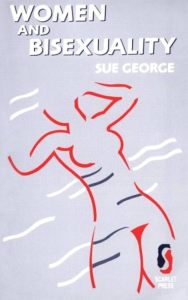
George highlights how simplistic it is to imagine that bisexual+ people are abandoning what is “personally or politically difficult” and are taking only what is “positive and pleasurable”, ignoring a long history of bisexual+ activism and organising within the LGBTQ+ community.
In the 1973 article published by The Furies, Ulmschneider maintains that she believes in the validity of bisexuality, “as lesbians/feminists we affirm the bisexuality of human nature”. Yet, she finishes her essay with a firm statement, “women who practice bisexuality today are simply leading highly privileged lives that do not challenge male power and that, in fact, undermine the feminist struggle“10.
Perhaps it goes without saying that this is an incredibly misogynistic, biphobic, and reductive perspective. It was written a long time ago after all, and is an interesting and important record of attitudes towards bisexuality in 1970s American lesbian separatist feminism. However, it’s also an important reminder of why understanding and making bisexual+ history accessible is so important.
To finish, here’s a quote from June Jordan which I feel sums up my own perspective on things:
“To my mind, that is the keenly positive, politicizing significance of bisexual affirmation… to insist upon the equal validity of all the components of social/sexual complexity”11.
Read more about bisexuality is freedom and June Jordan
Read the full PDF of The Furies article on bisexuality via the Rainbow History Project
- https://www.ons.gov.uk/peoplepopulationandcommunity/crimeandjustice/articles/womenmostatriskofexperiencingpartnerabuseinenglandandwales/yearsendingmarch2015to2017
↩︎ - https://en.wikipedia.org/wiki/Feminist_separatism#:~:text=Separatist%20lesbianism%20is%20a%20type,with%20the%20broader%20feminist%20movements
↩︎ - https://archives.rainbowhistory.org/items/show/563 ↩︎
- https://archives.rainbowhistory.org/items/show/563 ↩︎
- https://www.newyorker.com/magazine/2009/03/02/lesbian-nation ↩︎
- https://www.newyorker.com/magazine/2009/03/02/lesbian-nation ↩︎
- https://materialfeminista.milharal.org/files/2012/10/Political-Lesbianism-The-Case-Against-Heterosexuality-LRFG.pdf ↩︎
- https://archives.rainbowhistory.org/items/show/563 ↩︎
- https://archives.rainbowhistory.org/items/show/563 ↩︎
- Sue George, Women and Bisexuality (Scarlet Press, 1993) ↩︎
- June Jordan, A New Politics of Sexuality ↩︎
 Bi History