
When I was in my early 20s I worked in a corporate office that shall remain unnamed. As is common in many offices, we had to wear our passes on lanyards. Everyone was issued a standard lanyard with the company logo on it. Some people (the lucky ones) had the style with a bit of stretchy elastic which made scanning your pass easier, but that was the scope of variety. And then came pride month.

The updated cross design on the official England team kit for the Euros 2024 (Nike).
I remember nervously composing my email response to the offer of a rainbow lanyard, it felt frightening to ‘out’ myself like this but exciting too. For the brief weeks of pride month, most of the office switched to rainbow lanyards. Then, on the 1st July almost everyone switched back. I wore mine for the rest of my time at that job and still have it in a drawer somewhere. It was a small gesture from the organisation, the bare minimum really. I knew that even at the time. But it meant that my workplace was committed in principle to inclusivity, which felt like something.
Of course, signalling like this is about more than just your personal identity or support for LGBTQ+ rights. Rainbow lanyards and badges have been used to indicate safety and acceptance in settings where that has a real impact on LGBTQ+ people. In 2018 the NHS Rainbow badge scheme was launched. More than just a symbol, the badge wearer had to undergo training and education before they took on the responsibility of signalling that they were an ally to the LGBTQ+ community. I notice it sometimes when I go to the doctors, that small rectangle of colour, indicating that I am safer here than I might have anticipated. It matters.
You may find yourself asking – what does this have to do with the new England football kit? For this new design, Nike has ‘redesigned’ the cross symbol that can be found on the flag of St George (and also in plenty of other places, given that it’s a cross – perhaps one of the most instantly recognisable symbols in the world). Using a purple, blue and pinky-purple colour scheme they’ve added stripes to the cross symbol that to some, seem comparable to the lines on a pride flag.
For accuracy’s sake, it’s important to note that the colour choices are supposed to be a nostalgic, vintage-esque reference to the 1966 kit. A cynic might suggest that Nike based the updated design on a pride flag style with those easily recognisable stripes, but in a more muted colourway, as a form of rainbow capitalism. Someone else might wonder if there were no bisexual+ people in the design room to point out the similarity between the design and the bi pride flag designed by Michael Page in 1998 and released without a copyright claim to allow everyone to use it freely. Or, maybe a rogue bisexual graphic designer snuck it in and no one else noticed. Perhaps those colours were just a coincidence. It’s a good colour scheme after all.
The visual similarities between the striped colours on the cross design and the bisexual pride flag have not gone unnoticed. Angry people on Twitter have sworn off Nike products because of it, and furious ranting is occurring across the internet. I was personally just surprised that the bi flag is widely known enough for the bigots to pick up on this potential symbolism. But then it is always dangerous to underestimate bigots.
People are upset because this new colour scheme apparently damages the history of the flag of St George, which is the flag of England – a red cross on a white background. I’ve personally always felt uncomfortable with the English flag, as an English person. For me, it recalls angry white nationalism or even the uniform of Christian ‘crusaders’ in medieval illustrations.
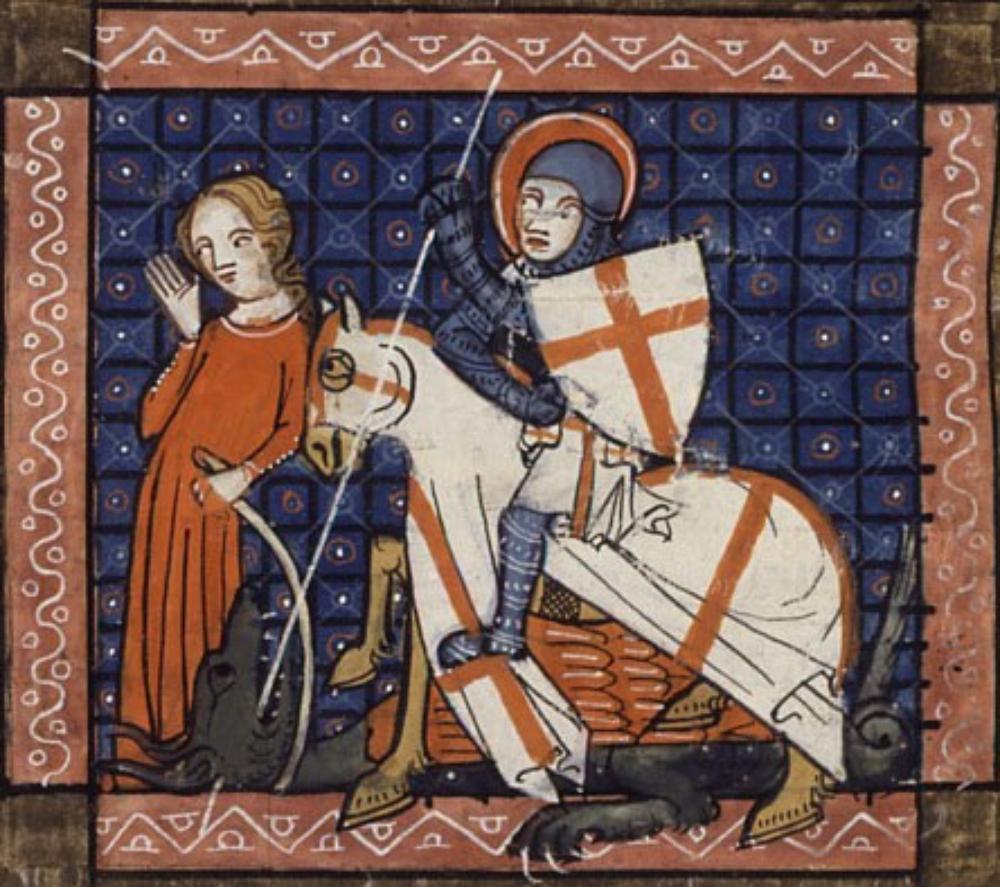
Miniature of Saint George and the Dragon, ms. of the Legenda Aurea, dated 1348 (BNF Français 241, fol. 101v.
At the same time as this football kit-based furore, recent changes in Scotland have meant that staff at the Scottish Parliament can no longer wear rainbow lanyards. It’s part of a wider decision to ban them from wearing anything which could be considered representative of a social movement. You might find yourself wondering if this is to ensure staff don’t wear anything with the Palestine colours on, but who’s to say? It seems a strange choice, especially given that being a member of the LGBTQ+ community is not in itself a political identity or social movement. It just so happens that there is a long history of activism and political action from LGBTQ+ groups and individuals, due to the oppression and marginalisation we experience. One small positive is that staff are still allowed to wear pronoun badges.
To me, these two events are linked. The decision to prevent staff at the Scottish Parliament from wearing lanyards or badges that may be viewed as political has removed their ability to wear anything indicating allyship or pride as LGBTQ+ people. At the same time, Nike – a private company – is experiencing a huge backlash because a product has been perceived as tangentially connected with LGBTQ+ identity. You may argue it’s about protecting the sanctity of a nation’s flag, or something else equally meaningless. But a quick read of the comments on any article or post about the subject makes it clear, the main goal here is to make even a hint of queerness unprofitable and unacceptable. There’s also a lot of racism to be found in these comments as well.

‘That’s the bisexual flag – I will not be buying the shirt nor will my son’
– A real tweet in the replies to Nike‘s kit announcement
Aside from the issue of how we all get sucked in by capitalism into seeing products and brands as our friends, what’s clear to me is that hatred of LGBTQ+ people is becoming more common and more acceptable. It’s not just angry people on Twitter, a steady radicalisation against queer people is ramping up. The landscape of our world is changing, and as the UK becomes more and more hostile to LGBTQ+ people (even the UN are concerned!) we need to keep standing up against every iteration of this hatred.
Symbols are used in many circumstances to represent who we are and what we stand for, whether that’s a bright rainbow pride flag or a red cross on a white background. We communicate our political beliefs and identities through the language of colours and shapes that have been attributed meaning culturally. Companies profit from this urge to be recognised by selling us the product that really shows who we are. The endless loop of capitalism is underpinned by the constant need for self-expression through consumption. We are sold the lie that we can become who we want to be by buying the right things and that we will be recognised for it and loved. To be clear, I am not above this – I am a sucker for nice sportswear as much as the next person, but it’s worth interrogating.
Private companies like Nike don’t owe us anything, they care about profit and brand identity (because that impacts profit). As amusing as it is to see people rail against them for daring to make something that frankly, some people seem worried makes a cross look gay, we need to remember they’ll only be on the right side of that conversation as long as it’s profitable. Brands are not our friends.
But when it comes to government, the people elected to represent us, it seems a lot more insidious that self-expression and a public show of acceptance of a marginalised community is being prohibited.
 Bi History