
A challenge you will face when exploring queer history is how to identify when something can be considered bisexual+ history. How do we know when we’re looking at bisexual+ history, if no one identifies themselves as bisexual+?
Some parts of our community’s history are easy to identify; the activists and community groups who named themselves as bisexual can be found and explored with some basic research skills and resources. This makes it possible to refute claims that bisexual+ people have not historically been active members of the LGBTQ+ community and queer activism.
But what about when bisexuality is less visible?
Applying labels to people:
The approach to identity where we choose a label and use this to explain and identify ourselves is a relatively recent phenomenon. It is important to bear in mind how this influences our understanding of our queer histories. Language changes and evolves, and when we look at a historical record, we often bring our own preconceptions which may need to be challenged.
It’s impossible to neatly categorise ‘gay’ history as one separate phenomenon, just as it is impossible to carve out solely ‘bisexual’ history. Human identity, love, and self-expression have existed in the forms we now understand as LGBTQ+ across time and place, and so are not always so neatly categorised. Our histories are intertwined as people have fought for their rights, and lived and loved together.
Unfortunately, I have seen firsthand in my work as an archivist how bisexual+ people can be erased from LGBTQ+ records. Unless the word ‘bisexual’ is specifically identified, or even used at all, parts of our community’s history can be overlooked or erased.
Identifying pieces of bisexual+ history where the word ‘bisexual’ is not used must be done carefully. Just as it’s not acceptable to decide for someone else how they should label their sexuality now, we can’t go around doing this for people who have gone before, no matter how long ago they lived. Yet, it’s still important to be able to research and identify bisexual+ history. So how do we do this?
Jeremy magazine – bisexuality in a gay 1970s publication?
The inspiration and primary source for this post came after reading a great piece by Ashleigh Craig, written for the Bishopsgate Institute blog. In it, we explore Jeremy, a subscription-only British ‘gay lifestyle magazine’ that ran from 1969. One reader felt “it was an attempt to provide the gay world with a magazine of its own.” (50 years of gay rights, BBC).
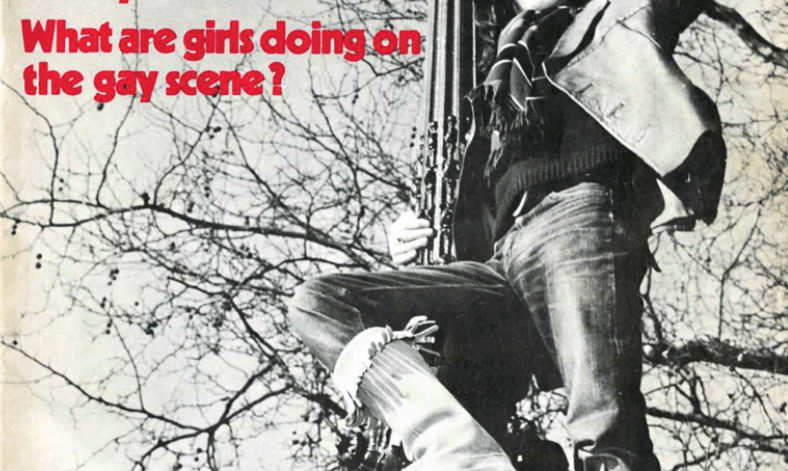
My attention was drawn by an article named on the front cover of Jeremy Magazine issue 7, titled ‘Girls On the Gay Scene’. I suspected this implied the piece contained some relevance to bisexual+ history…
‘Bi’ any other name:
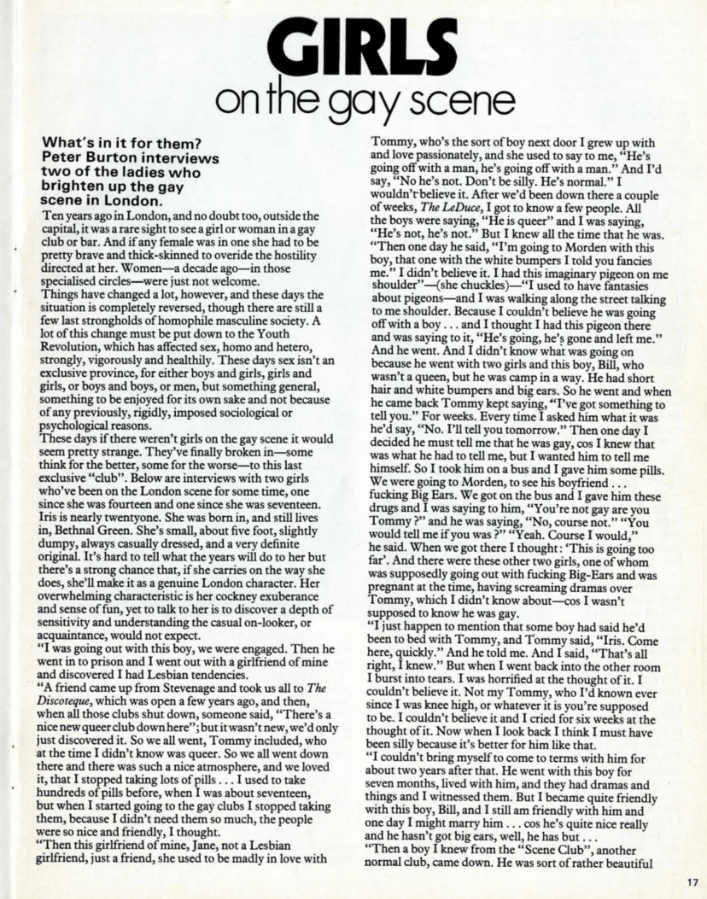
The 1970 article features an interview by Peter Burton with two young women about their experiences being part of the gay scene in London. Both have been involved in the community there for many years, “these days” he writes “sex isn’t an exclusive province, for either boys and girls, girls and girls, or boys and boys”, recognising a growing awareness of sexual fluidity within the gay scene, and a hint at what is to come in their conversations. The article, however, is mainly focused on the idea that these women are part of a predominantly gay male environment, implying to some degree that they are transgressing into a world that is not their own.
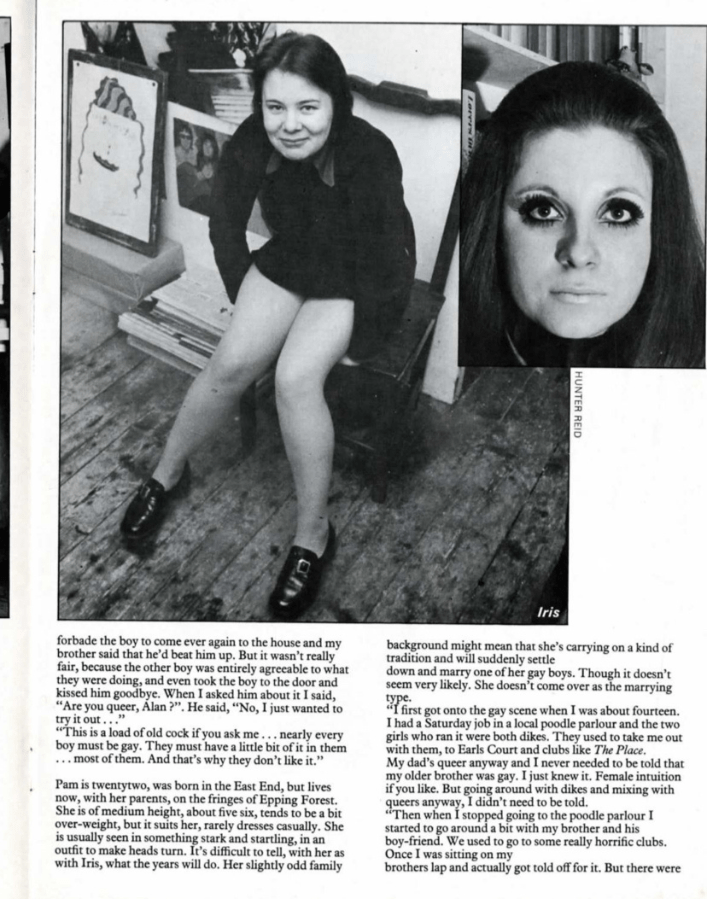
The first interviewee Iris is 20 years old, and describes how she has had relationships with men and women; “I was going out with this boy, we were engaged. Then he went in to prison and I went out with a girlfriend of mine and discovered I had Lesbian tendencies”.
She sees herself as a real part of the scene socially, but is hesitant when it comes to her own identity, saying; “I’ve been on the gay scene for three years now…sometimes I think I’m queer and sometimes I think I’m not. I do fancy girls occasionally, but I wouldn’t go with them. Although I have been with one or two in the past”.
Meanwhile, the other interviewee Pam, is 22 and came to be part of the community because she worked with two “dikes” who got her involved, and her dad and older brother are identified as queer and gay respectively. She shares her thoughts about the experiences of the men on the scene and their potential orientations: “everyone seems to be experimenting and there aren’t many of the younger gay boys, those under twentyfive, who’ve not been with at least one girl.”
In one “horrific” venue, she describes being told to leave after being “told off” for being close to her brother. Presumably, the hostility is aimed at them because they have been assumed to be an opposite-gender, ‘straight’ couple. Pam does not speak of her own experiences in as much detail as Iris, but she feels confident that most men have the potential to experience multi-gender attraction; “nearly every boy must be gay. They must have a little bit of it in them”.
How can this be bisexual+ history?
The individuals in this interview do not describe themselves as bisexual+, but they clearly show experiences of fluid sexuality that many bisexual, pansexual, or other sexually fluid people would identify with. From Iris’s hesitation to describe herself as an active part of the gay scene, despite multiple relationships with women, to Pam’s experience of feeling unwelcome in a bar because she was perceived to be in a different gender relationship.
These experiences form part of queer history, and perhaps more specifically the history of the bisexual+ community. We do not have to label either of the women as bisexual to recognise this – how they identify themselves and understand their own identities is valid, and valuable, and is also in of itself an experience that many questioning people would recognise. It would also be just as fair to say that these experiences are part of the lesbian or gay community, which takes us back to my earlier point about how LGBTQ+ history is intertwined.
This does not mean that we diminish anyone’s experiences or identities when we recognise bisexual+ history, instead, we are left with a more rounded and inclusive understanding of our community’s past.
References and further reading
- Why care about bisexual+ history? https://bihistory.wordpress.com/2023/09/20/why-care-about-bisexual-history/
- Craig, Ashleigh. “Jeremy Magazine: A Look Into Gay Life in the UK.” Bishopsgate Institute, https://www.bishopsgate.org.uk/archives/our-archives-online-2/jeremy-magazine. Accessed 5 February 2024.
- de Castella, Tom. “How we got to now.” BBC, 3 August 2017, https://www.bbc.co.uk/news/resources/idt-sh/lgbtq_how_we_got_to_now. Accessed 5 February 2024.
- Jeremy Magazine. Volume 1, Number 7 ed., Peter L Marriot, 1970, https://www.bishopsgate.org.uk/archives/our-archives-online-2/jeremy-magazine.
 Bi History